

SKIP TO CONTENT
moonsdata
Darren working on HELM on the lunar surface
[ CASE STUDY / 001 ]
— CASE STUDY / HELM

HELM. A compass
for people building
too many things.

ROLESolo builder, with AI
YEAR2026
STATUSIn development
STACKReact 19, TypeScript, Vite, Supabase, Capacitor, Gemini
[ ★ ]SCROLL TO EXPLORE
▼ ▼ ▼
[ TRANSMISSION 002 ]
— THE PROBLEM

Most productivity apps
were built for people
with one job.

That's never been me.

I have a job search to run, an app to build, and this website to design and write. There are three side ideas in my notebook that I keep promising myself I'll get to. My biggest problem has never been a lack of ideas. It's that I want to work on all of them at once.

Every productivity or goals app I tried wanted me to pick one. One project, one goal, one focus. They assumed the problem was that I didn't know what I wanted. The real problem was the opposite. I knew exactly what I wanted to do. I just didn't know where to start, or what to do next.

So I built the thing I wished existed. A productivity app for people who refuse to pick. People with lots of ambitions who need structure to reach them, and a compass that keeps updating as they go.

[ TRANSMISSION 003 ]
— THE PRODUCT

HELM shows you
one thing.
The next thing.

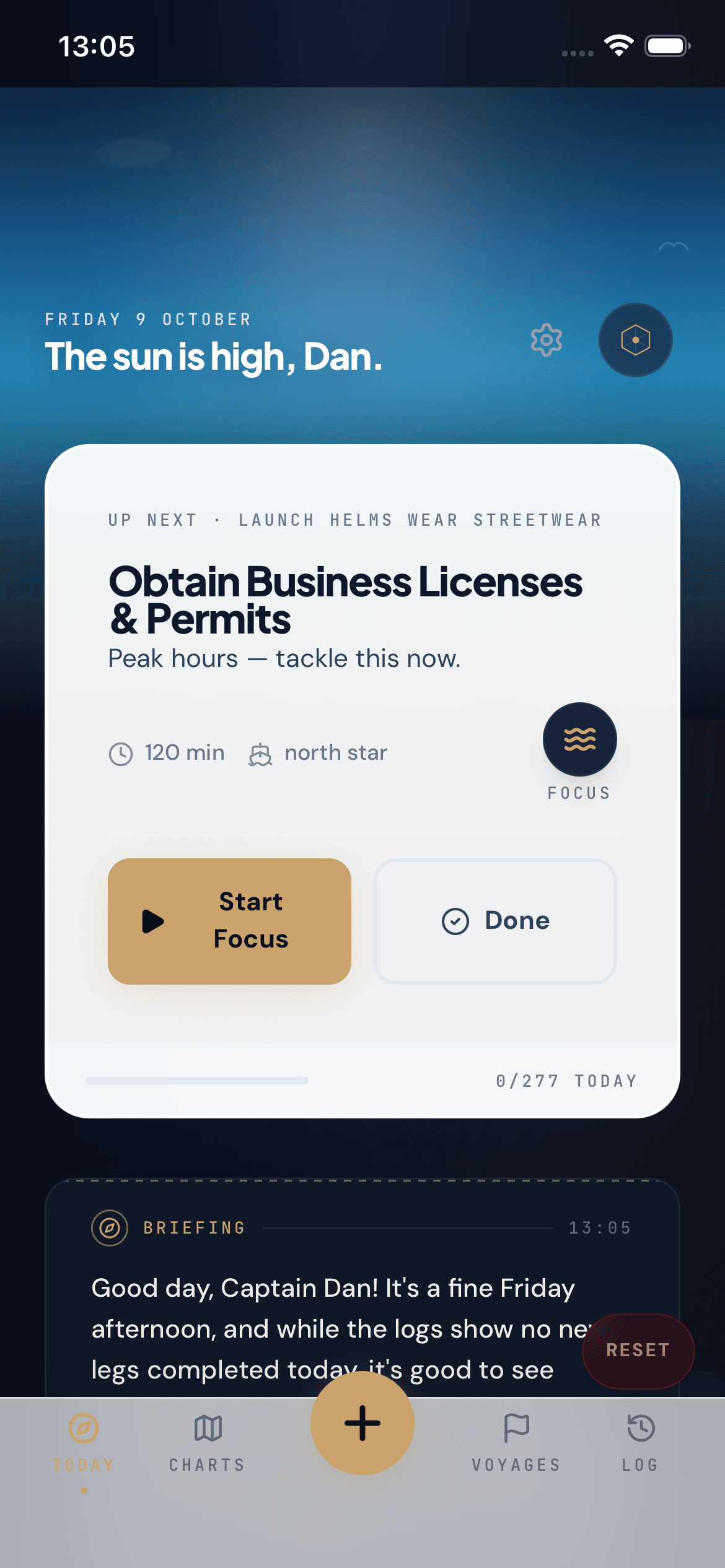
HELM doesn't show you a to-do list. It shows you a single Leg. The one you should be doing right now. To pick it, HELM looks at what matters most to you, what's due soon, and how much time and energy you've got today.

You finish that Leg. HELM picks the next one. That's the whole loop.

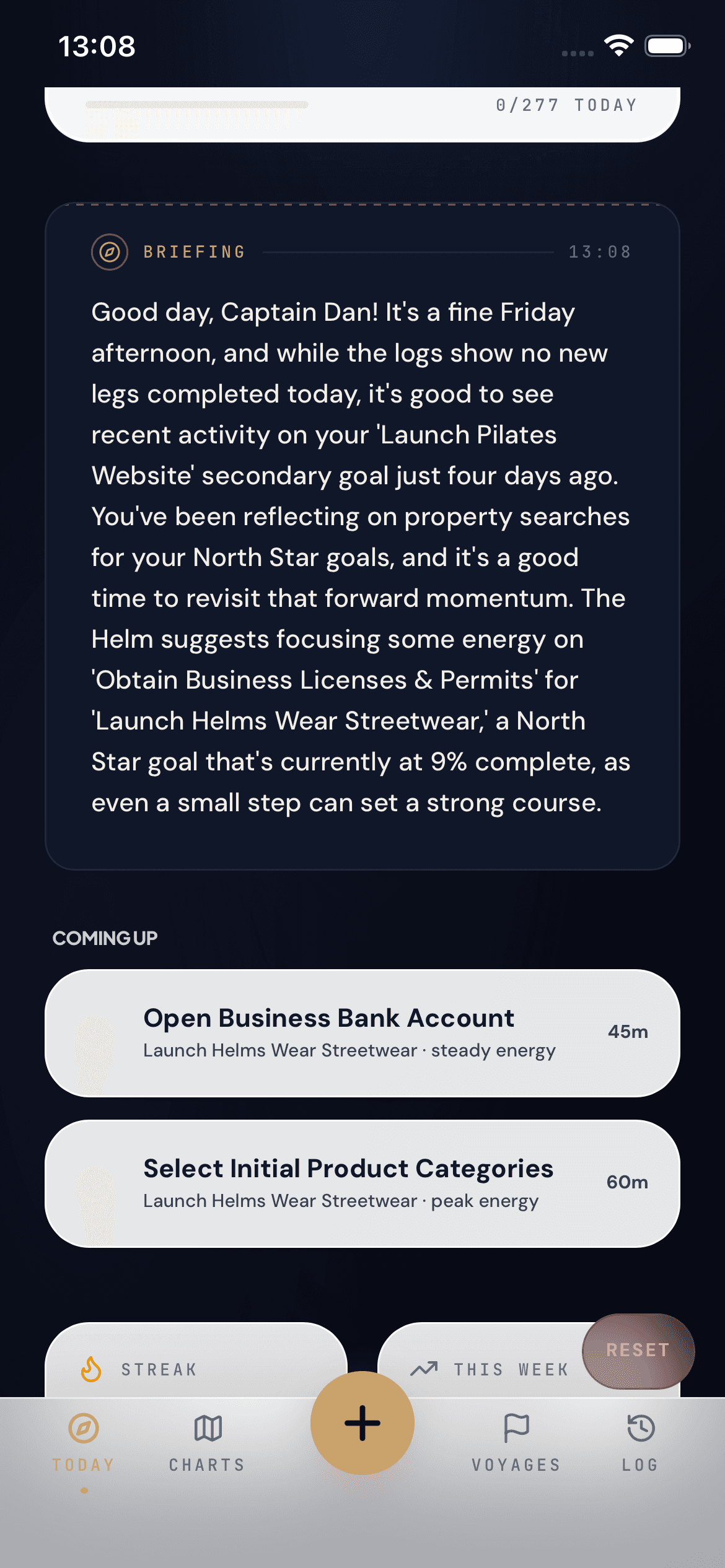
Every Leg comes with a reason. HELM doesn't just tell you what to do next. It tells you why. If it's your peak hours, it'll say so. Below that sits the Briefing, a short note written by AI that looks at your Voyages and recent progress and tells you, in plain English, where you stand and what to focus on.

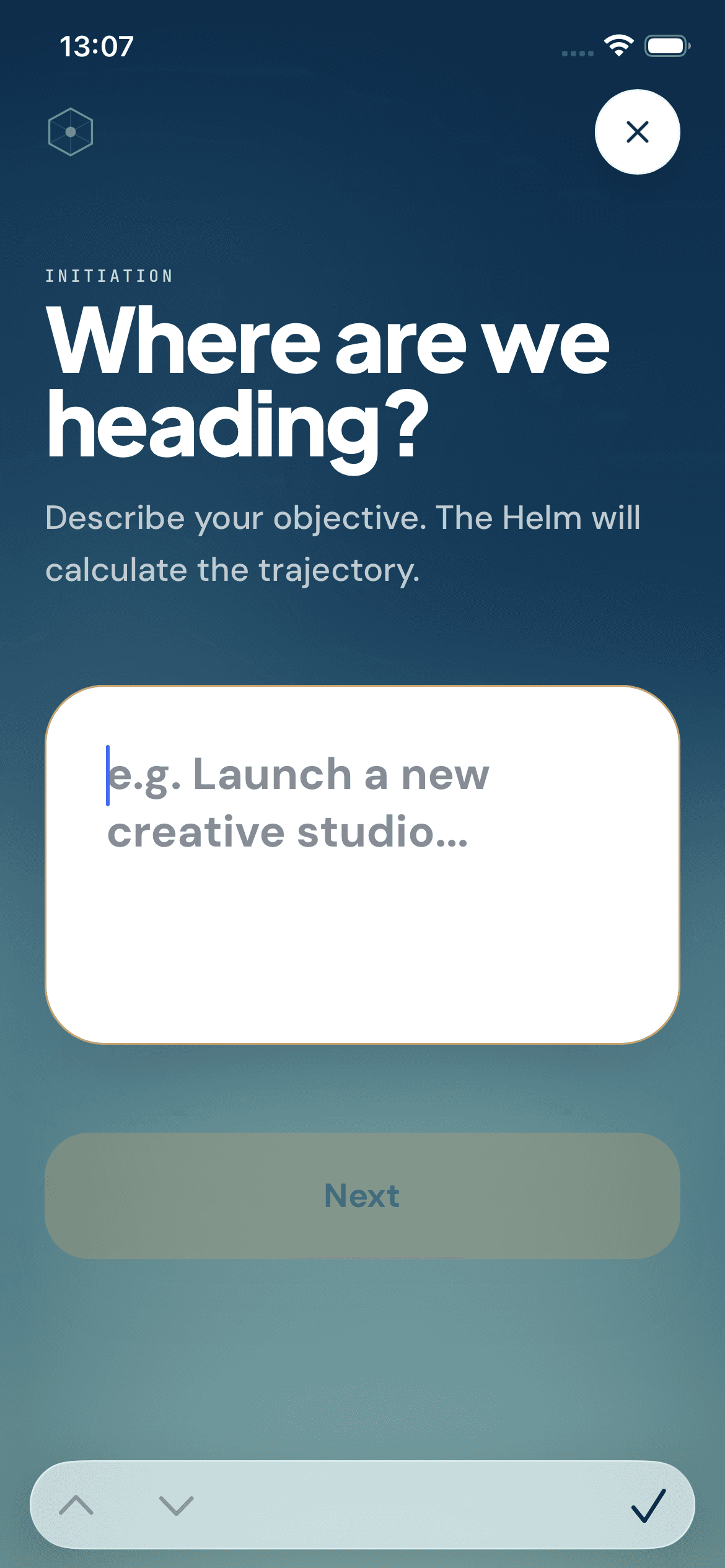
The AI does more than write briefings. Tell HELM where you're heading and it breaks the goal into Legs for you. When you finish a run of Legs, it suggests what could come next. In the evening it asks you one short question to reflect on, and on Sunday it writes up your week. But the AI doesn't pick your next Leg. The engine does. The AI's job is to explain that decision in a way that feels human.

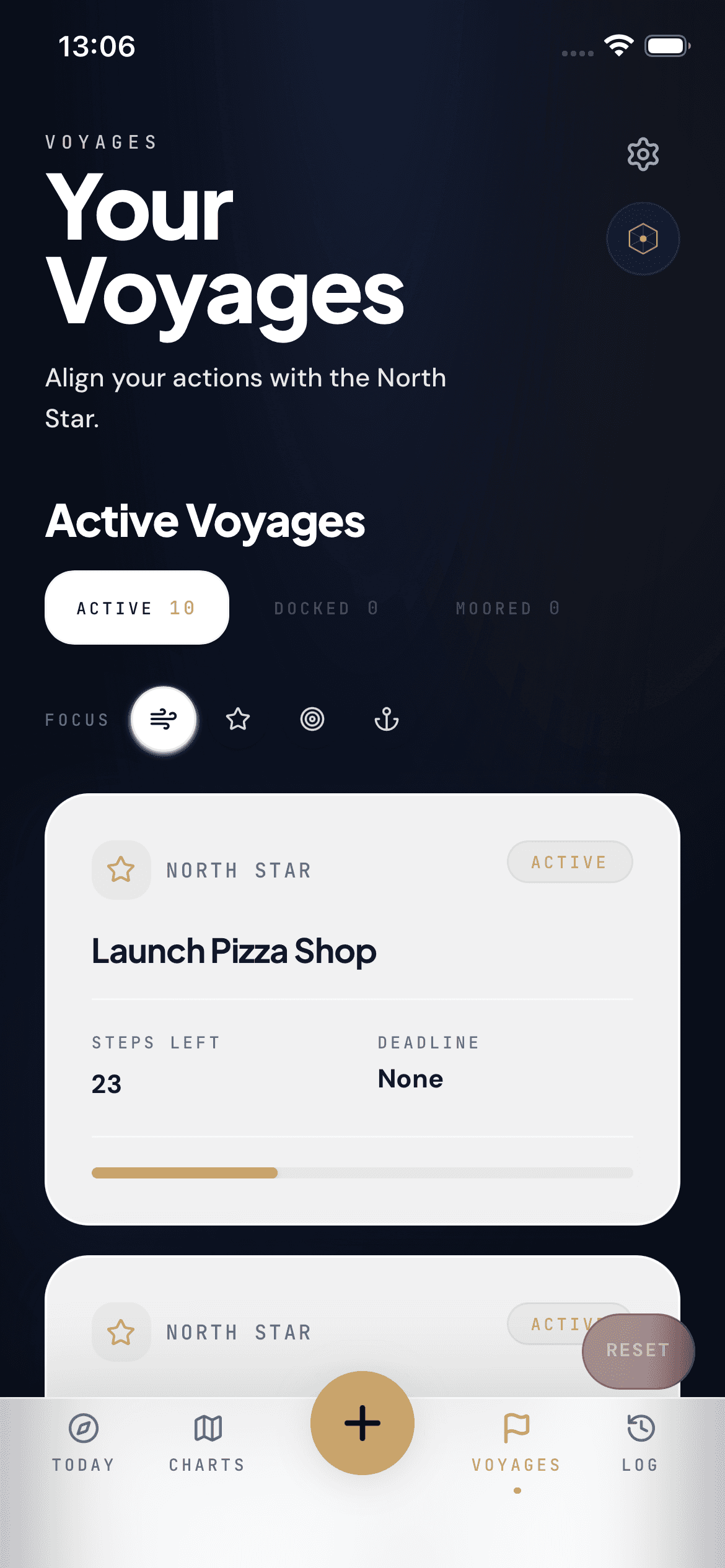
Underneath it all is the system. Voyages are the big things you're working on. My MSc was a Voyage. Building HELM is a Voyage. This website is a Voyage. My job search is a Voyage. Each Voyage is broken into Legs, the small steps that move it forward. Your North Star Voyages are the ones you care about most right now. Everything else is a Bearing or a Drift. When things are quiet, you're in Calm Waters. When you're moving fast, you're In Open Sea.

The nautical theme isn't just for looks. It's how the app thinks. You're the captain of several journeys at once, and HELM helps you hold the wheel.
HELM Today screen in development
— HELM / TODAY VIEW (IN DEVELOPMENT)

— INSIDE THE APP / IN DEVELOPMENT

HELM Today screen showing the Up Next leg and its reason
TODAYOne Leg, and the reason it won.
HELM Briefing screen summarising Voyages and recent progress
BRIEFINGAn AI-written summary of where things stand.
HELM Voyages screen showing priorities and remaining steps
VOYAGESEvery Voyage with its priority and steps left.
HELM Initiation screen asking where a new Voyage is heading
INITIATIONEvery Voyage starts by asking where you're heading.

Screens from the current build. Test data. Design still changing.

[ TRANSMISSION 004 ]
— THE BUILD

I didn't write
the code.
I directed it.

HELM is built with React 19, TypeScript and Vite. The backend runs on Supabase, and Capacitor turns it into an iOS app. Before HELM, I'd never even heard of some of these tools, let alone worked with them.

I'm not a software engineer, and I've never claimed to be. Hats off to the people who are. Even with AI helping, building an app takes a lot more understanding than people think. I'm someone who enjoys building things, and AI made it possible for me to build an app on my own.

Claude was the main brain. It wrote most of the React, helped me come up with ideas, wrote the prompts I gave to Antigravity and went through my code with me. I'd tried Windsurf and other IDEs before, but Antigravity was the one that clicked, and it handled the file structure. Figma and Figma Make helped me design the first screens and wireframes, and Google AI Studio let me try out features in plain English before they became real code. Figma held the design system. I decided what got built, how it should work, and what good looked like.

People call this vibe coding, and some say it like it's a joke. I don't see it that way. It's been one of the best ways I've found to learn, and it's shown me what really goes on behind the scenes of an app. It's not as simple as asking Claude to build you an awesome app and calling it done.

What it actually takes, if you want to do it well.

  1. 01A clear picture of what you're building, right down to how someone moves through each screen.
  2. 02Enough technical knowledge to read code, spot when the AI is wrong, and turn down bad output without stalling the whole project.
  3. 03Patience. AI is a fast collaborator, not a magic wand.
  4. 04A willingness to learn the parts you can't avoid. Building HELM taught me more about React, state management and databases than any course would have. It also taught me about product design, borrowing ideas from apps I admire, and what it takes for a backend to scale.
  5. 05Respect for the work. It's shown me how much goes into being your own full stack designer.

I'm not trying to pass this off as engineering. You still need a real level of knowledge, and a lot of learning on your own. The point is understanding the why, not letting AI make every decision for you. If anything, HELM has made me more curious. I want to properly learn React, TypeScript and more programming languages. But Python comes first.

FIGMA MAKE

first designs

AI STUDIO

prototype

FIGMA

design system

CLAUDE

the main brain

ANTIGRAVITY

the IDE

CAPACITOR

iOS build

[ TRANSMISSION 005 ]
— THE HELM ENGINE

The scoring engine
is the whole point.

Anyone can build a to-do list. HELM exists because of the engine underneath it.

Every Leg gets a score, built from six factors. The highest score becomes today's focus.

PRIORITY

How much this Voyage matters to you right now.

ENERGY MATCH

Whether the Leg suits the energy you have at this time of day.

DEADLINE

How soon it's due, and how much work is left before then.

MOMENTUM

Whether you've been making progress on this Voyage lately.

DURATION FIT

Whether it fits the time you've set aside today.

WORK STYLE

Whether you prefer long deep sessions or short bursts.

The weights are the opinion. Priority and energy have the biggest say, on purpose. A North Star Leg will almost always win, unless something less important has a deadline bearing down on it. HELM is built to keep you on what matters, not what's shiny.

Energy is a real constraint, not decoration. The same Leg that wins in the morning can drop down the list after lunch, because the engine steers you away from heavy work when you're running low.

Then it explains itself. Once a Leg wins, the engine picks the strongest reason, whether that's a close deadline, top priority, peak hours or momentum. That one line is what you see on the Today card. In the screenshot above, it picked peak hours.

— TRY IT

[ SAMPLE DAYS ]

Choose a sample day or adjust the controls below.

ENERGY RIGHT NOW

In the app this comes from the clock and your peak hours.

TIME TODAY

WORK STYLE

TODAY'S FOCUS

Next career move

Tailor an application for a role I want

Peak hours, tackle this now

  1. 01

    Tailor an application for a role I want

    Next career move

  2. 02

    Review the week and plan the next steps

    Finding direction

  3. 03

    Reply to an interview invitation

    Next career move

  4. 04

    Build the first version of a dashboard

    Portfolio project

  5. 05

    Read a chapter and save a few notes

    Learning Python

A simplified version of the engine, with sample data. The real weights stay inside the app.

The opinion is the product.

[ TRANSMISSION 006 ]
— WHAT I LEARNED

Six things
I didn't know
when I started.

01.

Building with AI is a real skill, but only if you know what you're building. The bottleneck is taste, not typing speed.

02.

Getting the algorithm right is harder than building the UI. The visible parts are fast. The thinking underneath is slow.

03.

The backend is the part nobody sees and everything depends on. If your data doesn't save, sync and load properly, the nicest screen in the world is useless. Getting it to work is what makes an app feel real.

04.

There's an art to building an app. Every screen is a step in someone's journey, and if one step feels confusing, people leave. Thinking about the user journey changed how I designed every part of HELM.

05.

Building the app is only half the job. The more I looked into the App Store, the more I realised it's not as simple as uploading it and waiting. It's crowded, there are rules to follow, and you have to give people a reason to pick yours.

06.

Saying no is part of building. Every feature I add makes the app harder to finish. Deciding what to leave out has been as important as deciding what to build.

[ TRANSMISSION 007 ]
— STATUS / WHAT'S NEXT

HELM is still
being built.

HELM is in active development. It isn't on TestFlight or the App Store yet, and nobody else has used it so far. The scoring engine is written, and Voyages, Legs and the North Star are taking shape.

Next is getting it stable enough to test properly on my own phone, then TestFlight with a small group of people who juggle too many things, like me.

If you want to follow along, sign up below and I'll email you when there's news. Build logs also go up on the writing page when there's something worth saying.

— HELM UPDATES BY EMAIL

Build logs and HELM news, straight to your inbox. Only when there's something worth reading.

Occasional build logs. Unsubscribe any time.

— END OF TRANSMISSION 007